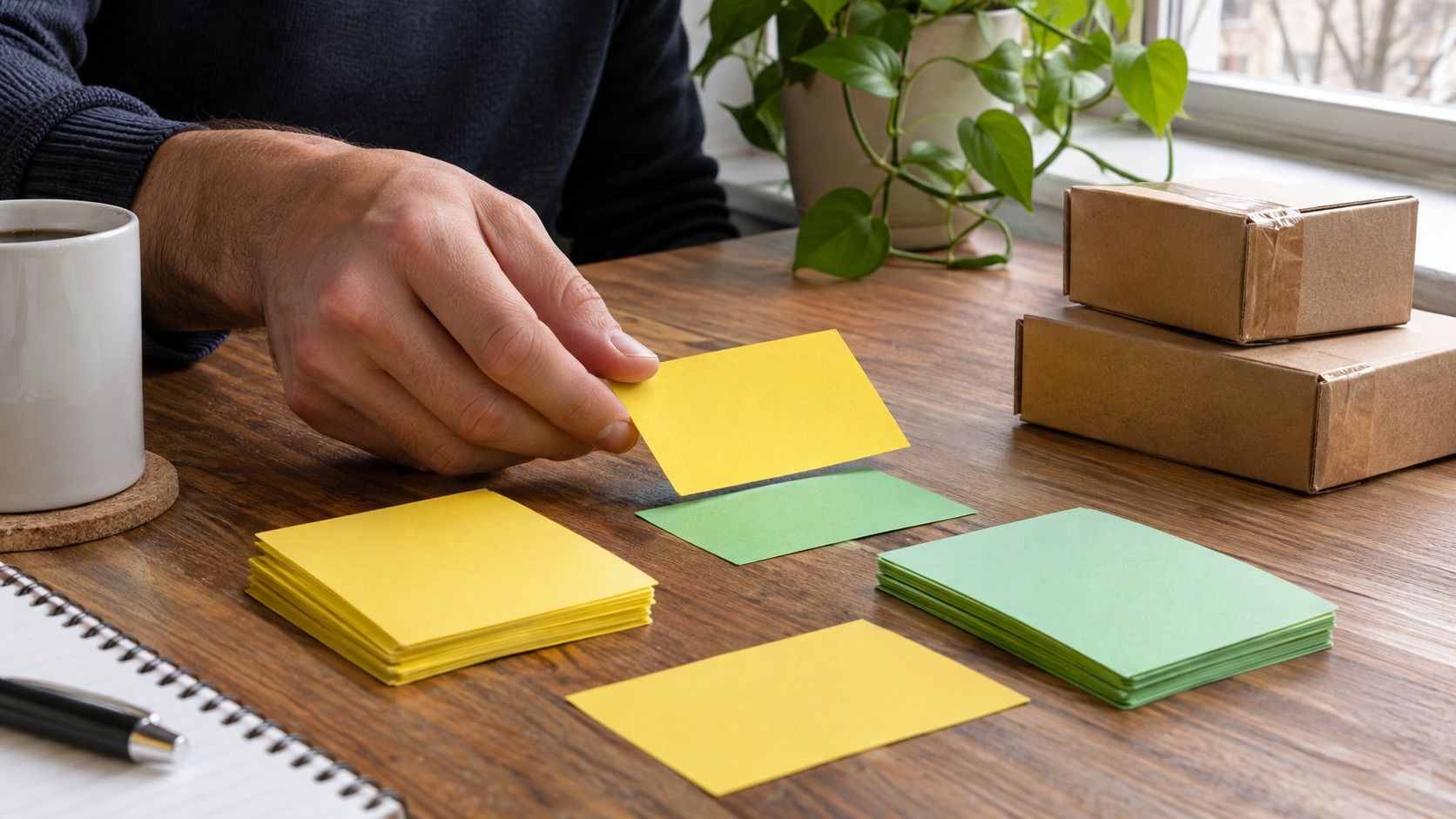
Memory practice should tell you what you actually observed, not how convincingly you can fill in a scene afterward. For CJBAT preparation, use fresh everyday scenes, remove the source before answering and review the difference between a remembered detail and a reasonable guess. A steady scanning routine is more useful than repeatedly testing the same familiar picture.
Scan a scene with a repeatable route
Start with a simple physical scene at home: a desk, a shelf or a small arrangement of objects. Move your attention in a consistent direction, such as left to right and then foreground to background. The route helps you visit the entire scene instead of staring at the most colorful object. It is a practice habit, not an official prescription for how a test image must be studied.
Notice broad layout before fine details. Identify the main objects and their positions, then inspect colors, counts and distinctive features. A blue notebook to the left of a mug is more useful to recall than an isolated impression of blue. Relationships give details a place in your memory. Keep the description factual rather than imagining who used the notebook or why it was left there.
Do not spend the whole observation period on a difficult detail at the expense of the rest. If one small label is unreadable, move on and mark it unknown later. In home practice you control the scene, so begin with clear objects and modest complexity. Add more elements only after you can describe a simple arrangement accurately without returning to look.
Group details without filling in gaps
Grouping can reduce the number of separate details you need to hold. A desk may have writing tools on one side and a mug with a coaster on the other. Remembering those groups can help you retrieve individual objects. The grouping must come from the scene. Do not assume that a notebook comes with a pen unless a pen is actually visible.
Separate an object's identity, color and position. You may remember a key ring but not its color, or a red object without knowing exactly what it was. Preserve that uncertainty. Turning a partial impression into a confident complete description makes the review less useful. You need to know which part of the observation failed so you can adjust your scanning.
Be cautious with expected objects. A desk scene can make you imagine a lamp, a phone or a chair even when none was shown. Familiar settings invite this kind of completion. During recall, ask whether you can locate the detail within your mental scene or whether it simply belongs in a typical office. The second is a guess, even if it turns out to be correct.
Remove the scene before answering
Cover the arrangement or turn away before you answer. Looking back between questions changes a recall exercise into a searching exercise. Both can be useful for different skills, but they should not be mixed without recording it. If you accidentally see the source, mark the attempt assisted and use a new scene for your next clean trial.
Prepare questions in advance when studying with a partner. Ask about counts, positions, colors and object relationships that can be verified directly. Avoid a question such as why was the mug there, because the scene does not show motive. A better question is whether the mug was on the notebook's left or right. Good memory questions have answers grounded in visible details.
For solo work, arrange a scene, take a short observation, cover it and write a factual description. Then compare the description with the source. You can also use a partner's fresh arrangement on another day. Record the observation and recall intervals you chose, but do not present those home settings as the official CJBAT timing. Current provider materials govern the actual examination.
Try an original desk scene exercise
Set up this original home exercise using safe ordinary objects: a closed blue notebook near the center, a plain white mug to its right, two pencils to its left and a key ring behind the notebook. Place one pencil horizontally and the other diagonally. Observe the arrangement, hide it and answer without rereading these setup instructions. The purpose is to practice a method, so the exercise becomes less informative once you know the arrangement by heart.
Ask: How many pencils were present? Two. Which side held the mug? The right side of the notebook. What was behind the notebook? The key ring. Was the notebook open? No. What color was the table? That was not specified in these written instructions; use your actual physical scene if you arranged one, and do not pretend the text supplied an answer it did not.
For the next attempt, have a partner change several details while keeping the overall difficulty similar. Use a different notebook color, move the mug or change the pencil count. If the old arrangement intrudes on your recall, note that interference. It explains why repeated success on one memorized scene is weaker evidence than accurate recall across several unfamiliar scenes.
Measure recall across fresh scenes
Record correct details, missing details and invented details separately. Forgetting an object and adding an object are different errors. If you miss items at the edges, change your scanning route. If colors are weak but positions are strong, devote a second pass to color-object pairs. If you invent expected office objects, slow the transition from observation to description and preserve unknowns.
Keep practice sessions short enough to review carefully. Ten scenes completed without analysis can hide the same recurring problem. Two fresh scenes with an honest comparison can show whether a change in method helped. Vary the objects and arrangement while keeping lighting and visibility reasonable, so poor image quality does not become the main challenge by accident.
Do not use a home recall percentage as an official pass forecast. Independent scenes, question difficulty and scoring differ from the examination. Look instead for transferable improvement: a complete scan, fewer invented details and a clear distinction between remembered information and uncertainty. Follow the instructions presented at your actual appointment rather than forcing a home routine onto a different task.